




 |
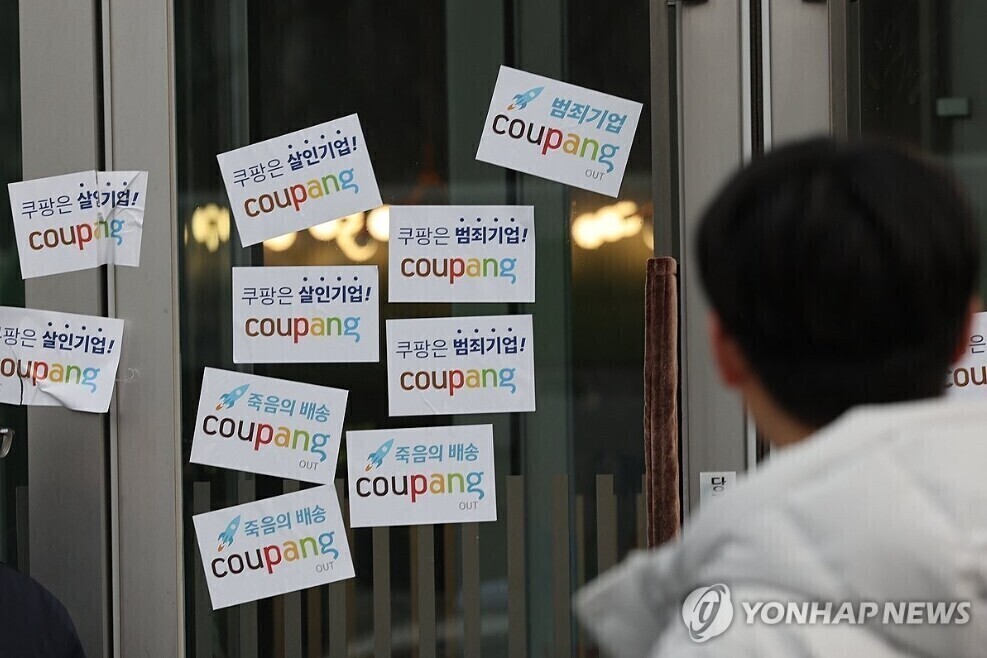
Stickers condemning Coupang posted at Coupang’s headquarters in Songpa-gu, Seoul, on the 29th. (Photo: Yonhap News) |
[Alpha Biz= Kim Jisun] Calls are growing for South Korea’s National Pension Service (NPS), a shareholder in Coupang, to take a more active role in exercising shareholder rights following the e-commerce giant’s personal data breach. Critics argue that failures in information security and alleged false disclosures have undermined market trust and caused shareholder losses, underscoring the need for the pension fund to act as a “responsible investor” rather than a passive one.
Collective action by Coupang shareholders is also gaining momentum. According to investment banking and legal industry sources on the 25th, law firm With the People filed a class-action lawsuit on January 7 at a federal court in Seattle, Washington—where Coupang’s U.S. headquarters is located—on behalf of Korean Coupang shareholders.
Coupang disclosed the data breach on November 29 last year. On December 1, the first trading day following the disclosure in the U.S. market, its share price plunged 5.36% in a single day. Further declines followed after a filing with the U.S. Securities and Exchange Commission (SEC) on December 16, bringing the total drop to 10.56%. Attorney Lee Young-gi of With the People said, “Given Coupang’s market capitalization of approximately KRW 72 trillion, the decline can be arithmetically estimated at up to KRW 7 trillion,” adding that “the exact amount of damages will be determined through a damages assessment process.”
All Coupang shareholders, both domestic and overseas, are eligible to participate in the class action. U.S. class-action lawsuits generally do not require plaintiffs to bear legal costs even if they lose, lowering the barrier to participation. As of December 2024, the NPS held approximately KRW 218.1 billion worth of Coupang shares, equivalent to about a 1% stake, making it one of the stakeholders affected by the incident. Attorney Lee emphasized that “for the NPS, which manages citizens’ retirement funds, exercising shareholder rights in cases of corporate value erosion is not a matter of choice but a fiduciary duty and responsibility.”
Similar cases are common in the United States, where shareholder class actions are routine. For example, Google faced a shareholder lawsuit over its failure to timely disclose a Google+ data breach in 2018, and in February 2024 reached a settlement of USD 350 million (approximately KRW 460 billion).
Meanwhile, the NPS has confirmed that it is pursuing dialogue with Coupang’s management regarding the data breach. According to the Ministry of Health and Welfare, the NPS has requested talks with Coupang through an overseas advisory firm. At this stage, the move is understood to be preliminary in nature, focusing on fact-finding rather than immediate action.
Alphabiz Reporter Kim Jisun(stockmk2020@alphabiz.co.kr)