




 |
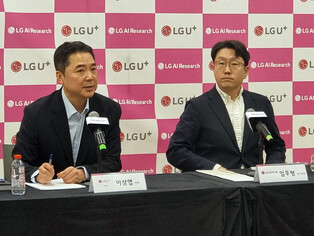
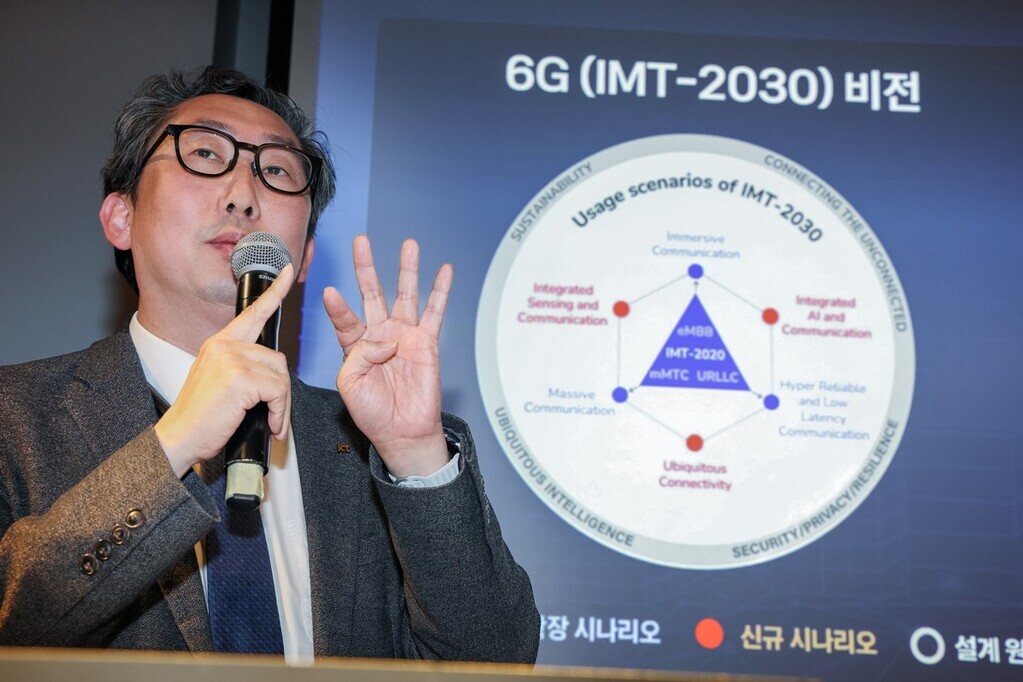
Lee Jong-sik, executive vice president and head of KT’s Future Network Laboratory, introduces KT’s 6G vision and key technologies. (Photo: KT) |
[Alpha Biz = Reporter Lee Joonhyun, Barcelona] KT unveiled its vision for next-generation 6G mobile communications, emphasizing the development of intelligent network infrastructure that integrates artificial intelligence with advanced connectivity technologies.
At a press briefing held on March 2 (local time) during Mobile World Congress (MWC) 2026 in Barcelona, KT presented its 6G vision centered on “ubiquitous connectivity, ultra-reliable communications and intelligent AI-driven networks.”
Lee Jong-sik, executive vice president and head of KT’s Future Network Laboratory, said the company’s 6G strategy focuses on building an intelligent infrastructure where networks and AI are deeply integrated.
“The 6G vision proposed by KT aims to combine networks and AI to create an intelligent infrastructure,” Lee said. “While our 5G strategy focused on achieving global leadership in speed, our 6G approach will prioritize innovations in customer experience and improvements in cost structures that customers can actually feel.”
KT outlined six key technologies that will underpin its 6G architecture: ubiquitous connectivity, hyper-reliable communications, quantum-safe security, AI-native networks, autonomous networks and semantic communication.
To enable ubiquitous connectivity, KT plans to establish three-dimensional network coverage spanning land, sea and air. The company will adopt Reconfigurable Intelligent Surface (RIS) technology to eliminate signal blind spots in urban areas and develop supercell technology to build emergency communication networks capable of covering more than 90 percent of the national territory during disasters.
For ultra-low latency communications, KT plans to implement end-to-end network slicing, linking the entire data path from devices to data centers. The company is also developing all-photonics network technologies, which process data using light signals without converting them into electrical signals.
In terms of security, KT plans to introduce a three-layer quantum security architecture. This includes Quantum Link, which expands quantum key distribution (QKD) to wireless and satellite links; Quantum Node, designed to protect network equipment from vulnerabilities; and Quantum Vault, which enables encrypted data to be processed through homomorphic encryption.
KT is also developing an AI Operator, a network-specialized large language model (LLM) trained on telecommunications equipment manuals and network fault management data, aimed at enabling autonomous network operations.
Lee noted that KT had internally questioned whether the company had fully achieved the goals it set during the 5G era, including acting as a “game changer” for the fourth industrial revolution, providing direction for the B2B market and delivering new customer experiences.
“For 6G, KT aims to go beyond simple speed leadership and focus on delivering tangible changes in customer experience,” he said.
Alphabiz 이준현 기자(wtcloud83@alphabiz.co.kr)