




 |
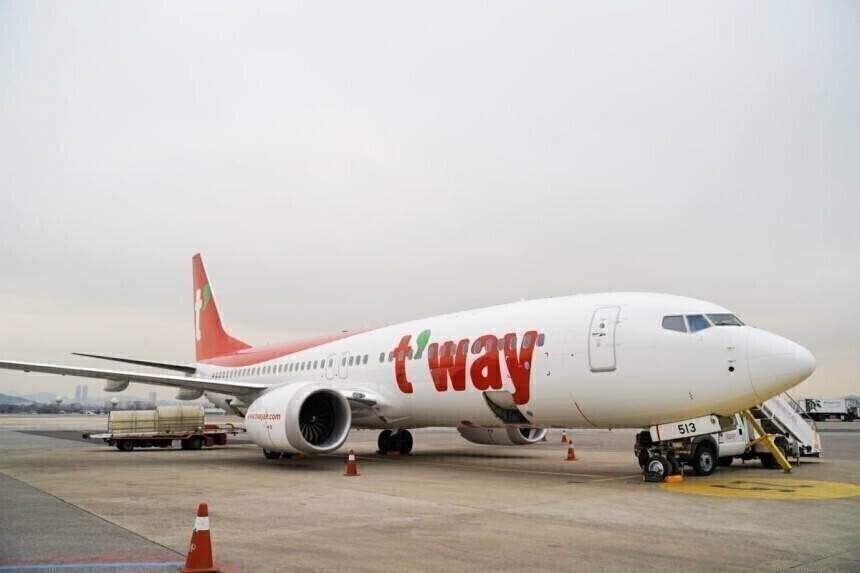
Photo courtesy of T'way Air |
[Alpha Biz= Kim Jisun] Korean airlines have been fined more than KRW 10 billion over the past five years for violations of aviation safety regulations, with T'way Air accounting for nearly half of the total penalties, according to data released on February 22.
Figures submitted by the Ministry of Land, Infrastructure and Transport (MOLIT) to the office of Rep. Moon Jin-seok of the National Assembly’s Land, Infrastructure and Transport Committee show that six Korean carriers violated the Aviation Safety Act a total of 28 times between 2021 and last year, resulting in cumulative fines of KRW 10.093 billion.
By airline, T’way Air ranked first in total penalties, receiving fines totaling KRW 4.744 billion across nine cases. The carrier was fined KRW 1.605 billion in May last year after it was found to have operated six flights using an A330-300 aircraft fitted with a hydraulic filter prohibited from reuse, and two additional flights without conducting required hydraulic oil sampling and composition tests.
The penalty was the largest single fine imposed by MOLIT for an Aviation Safety Act violation over the past five years. In August 2024, T’way Air was also fined KRW 1.2 billion for failing to follow maintenance manuals and for repairing and using parts outside its approved maintenance capability.
Jeju Air was fined a total of KRW 2.398 billion across five cases. The carrier exceeded the regulatory 48-hour limit for pre- and post-flight inspections (PR/PO) on two B737-800 aircraft and failed to follow proper response procedures after engine defects were identified, allowing the same issues to recur. As a result, fines totaling KRW 800 million were imposed in May last year.
Korean Air received nine fines totaling KRW 1.453 billion, while Jin Air was fined KRW 1.339 billion in two cases. Asiana Airlines was fined KRW 154 million across two cases, and Air Busan received a KRW 5 million fine in 2024.
The findings underscore continued regulatory scrutiny of airline safety compliance in Korea, particularly as carriers expand fleets and operations amid a recovery in air travel demand.
Alphabiz Reporter Kim Jisun(stockmk2020@alphabiz.co.kr)