




 |
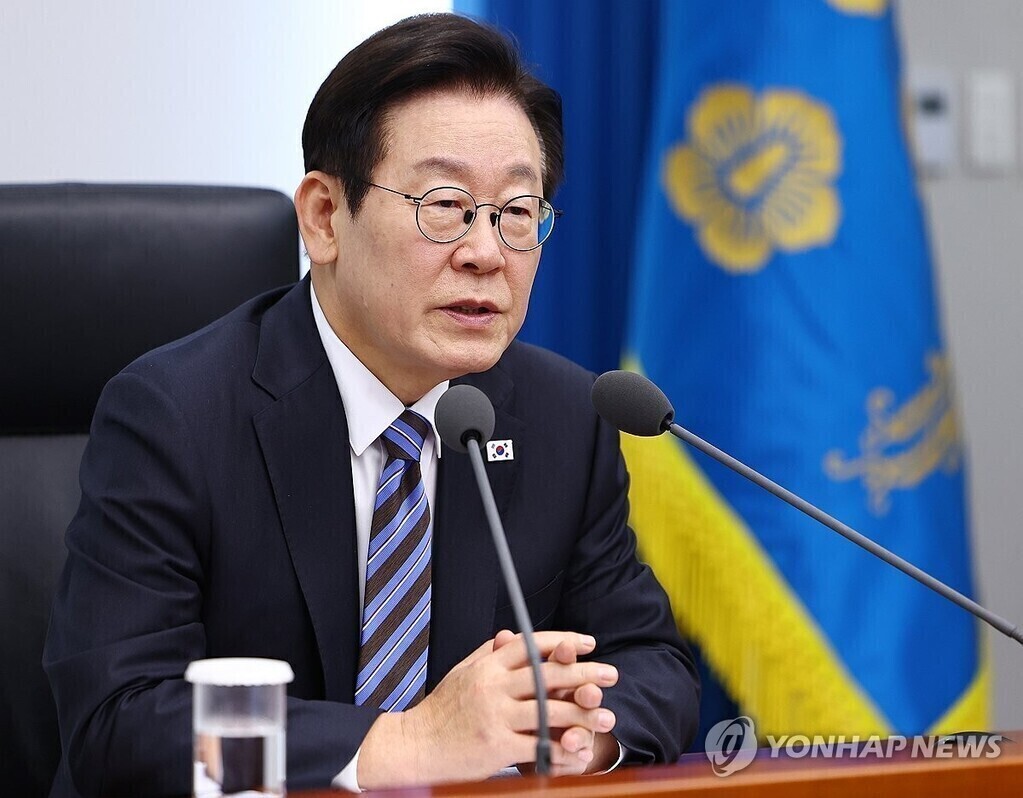
President Lee Jae-myung speaks during a senior secretaries’ meeting at the Presidential Office in Yongsan on the 13th (Photo: Yonhap News) |
[Alpha Biz= Kim Jisun] Top executives from major Korean semiconductor companies, including Samsung Electronics and SK hynix, called for regulatory reforms and policy financing support, arguing that preemptive investment is essential to capture rapidly growing global demand for artificial intelligence (AI). President Lee Jae-myung responded that “practical measures are being finalized.”
During the “Vision and Strategy for Nurturing Korea’s Semiconductor Industry in the AI Era” briefing held at the Presidential Office in Yongsan on the 10th, Jeon Young-hyun, Vice Chairman of Samsung Electronics’ Device Solutions (DS) Division, said, “Global hyperscalers such as OpenAI and NVIDIA are investing trillions of dollars in AI training, inference, and computing services. The scale of semiconductor investment required to meet this demand is beyond what individual companies can bear.”
Samsung Electronics currently spends over KRW 50 trillion annually on capital expenditures, but Jeon stressed that this remains burdensome given the intensifying global competition. Samsung is also pushing forward with investments of approximately KRW 360 trillion to establish a semiconductor mega-cluster around its Pyeongtaek campus and Nam-sa area of Yongin.
SK hynix CEO Kwak Noh-jung added, “Demand for AI memory will continue to rise, but supply remains limited. To secure the market, fabs and production lines must be built ahead of time.” SK hynix plans to invest approximately KRW 600 trillion in the Yongin cluster and KRW 11 trillion this year, with KRW 42 trillion allocated over the next four years for its Cheongju facilities.
Kwak emphasized that large-scale investments cannot be undertaken alone, noting, “It is difficult to secure massive funding, and thus regulatory improvements are necessary to facilitate investment. It takes more than three years to construct a semiconductor fab and install equipment. If we wait until we make money, the timing will already be too late. We must invest first and earn returns later.”
President Lee pointed out that Korea’s firewall between industrial and financial capital—known as the separation of industrial and financial capital —has become a constraint in financing large-scale investments in strategic industries.
He said, “Although the principle of separating industrial and financial capital is intended to prevent monopolistic abuses, it may actually hinder industrial development in sectors that require enormous investment, such as advanced semiconductors. We are finalizing practical measures to address this.”
알파경제 Kim Jisun Reporter(stockmk2020@alphabiz.co.kr)