




 |
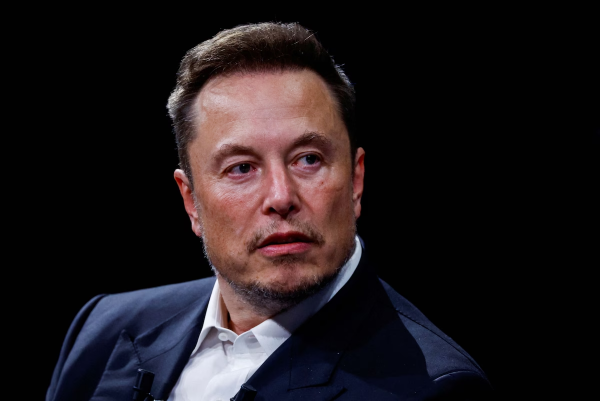
Elon Musk, CEO of Tesla. (Photo courtesy of Yonhap News Agency) |
[Alpha Biz= Kim Jisun] Tesla seeks AI chip designers in Korea as global competition for semiconductor talent intensifies
Elon Musk, CEO of Tesla, has drawn attention after posting a recruitment message aimed at Korean semiconductor professionals on his social media account.
On Feb. 17 (local time), Musk shared a job posting from Tesla Korea on X (formerly Twitter) for AI chip design engineers, adding 16 South Korean flag emojis. In the post, he wrote, “If you live in Korea and want to work on chip design, fabrication (fab), or AI software, apply to Tesla.”
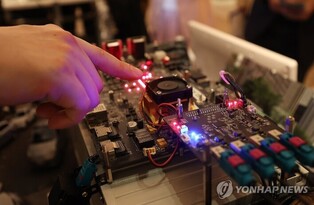
Tesla Korea had earlier announced on Feb. 15 that it was seeking talent to help develop “the world’s highest-volume mass-produced AI chips.” The company said the project aims to design an AI chip architecture that will eventually achieve the highest production volume globally.
The move is widely seen as an effort to strengthen Tesla’s AI competitiveness by securing talent from South Korea, a country widely regarded as a global powerhouse in semiconductors, amid rapidly expanding global investment in AI infrastructure.
Tesla is developing and manufacturing its own AI chips for autonomous vehicles and humanoid robots. In July last year, the company signed a foundry supply agreement worth about KRW 23 trillion with Samsung Electronics to produce its next-generation AI chip, known as A16, at Samsung’s Taylor, Texas, facility.
Tesla is not alone in this strategy. Major U.S. tech companies are increasingly focusing on developing application-specific integrated circuits (ASICs) tailored to their services. As a result, competition to recruit highly skilled Korean semiconductor engineers—who possess expertise in both memory technologies such as high-bandwidth memory (HBM) and advanced chip design—is intensifying.
South Korea accounts for more than 70% of the global memory semiconductor market. In particular, Samsung Electronics is considered an attractive talent pool for global tech firms, as it operates across foundry services as well as chip design and development through its System LSI division.
Industry sources say companies such as NVIDIA, Google, and Broadcom are expanding HBM-related hiring in the United States. With memory chipmakers including SK hynix, Micron Technology, and TSMC competing for talent—now joined by U.S. big tech firms—the global race for semiconductor expertise is expected to grow even more intense.
알파경제 Kim Jisun (stockmk2020@alphabiz.co.kr)