




 |
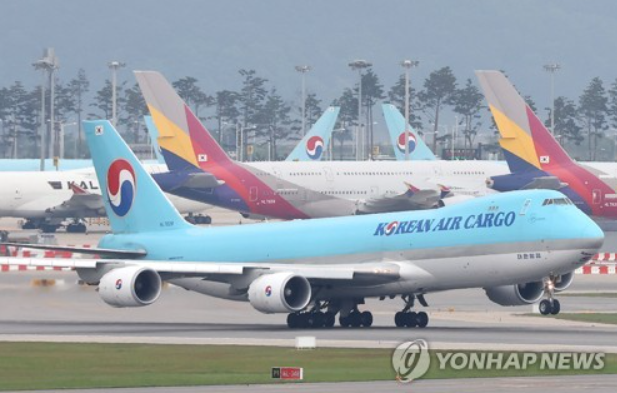
Photo courtesy of Yonhap News |
[Alpha Biz= Paul Lee] Recent government aviation statistics show that several international routes from regional airports—including the Busan–Guam route—are operating with extremely low passenger loads. Industry officials say the situation stems from supply obligations imposed by the Korea Fair Trade Commission (KFTC) as a condition for approving the Korean Air–Asiana Airlines merger.
According to data released by the Ministry of Land, Infrastructure and Transport on November 20, Korean Air flight KE2260, operating from Guam to Busan on November 7, carried only three passengers on a 180-seat aircraft. With two pilots and four cabin crew members onboard, the number of crew exceeded the number of passengers.
On November 1, a Korean Air flight departing Busan for Guam had just four passengers, and total round-trip passenger volume on the route for November 2 amounted to only 19 travelers. Other carriers required to operate the same route—Air Busan and Jin Air—also recorded average load factors of 10–20% per aircraft.
Under the KFTC’s merger-approval conditions, five airlines—Korean Air, Asiana Airlines, Jin Air, Air Busan, and Air Seoul—must maintain capacity on certain international routes (Busan–Guam, Busan–Cebu, Busan–Beijing, Busan–Da Nang, Busan–Qingdao) at no less than 90% of 2019 levels for the next ten years. The requirement was intended to prevent fare hikes and capacity reductions caused by market concentration.
However, as travel demand has shifted and some of these routes have become structurally unprofitable, airlines are now obligated to operate flights with load factors as low as 10%, resulting in significant inefficiencies. Industry analysts warn that the mandate may hinder efforts to launch new routes or revitalize regional airports, as aircraft capacity is tied up on low-demand services.
Airline officials argue that while the KFTC’s objective was to safeguard consumers, the rigid capacity requirement is now producing the opposite effect—burdening carriers with forced overcapacity on declining routes while limiting overall network development.
알파경제 Paul Lee 특파원(hoondork1977@alphabiz.co.kr)